Executive Insight
Issue 003
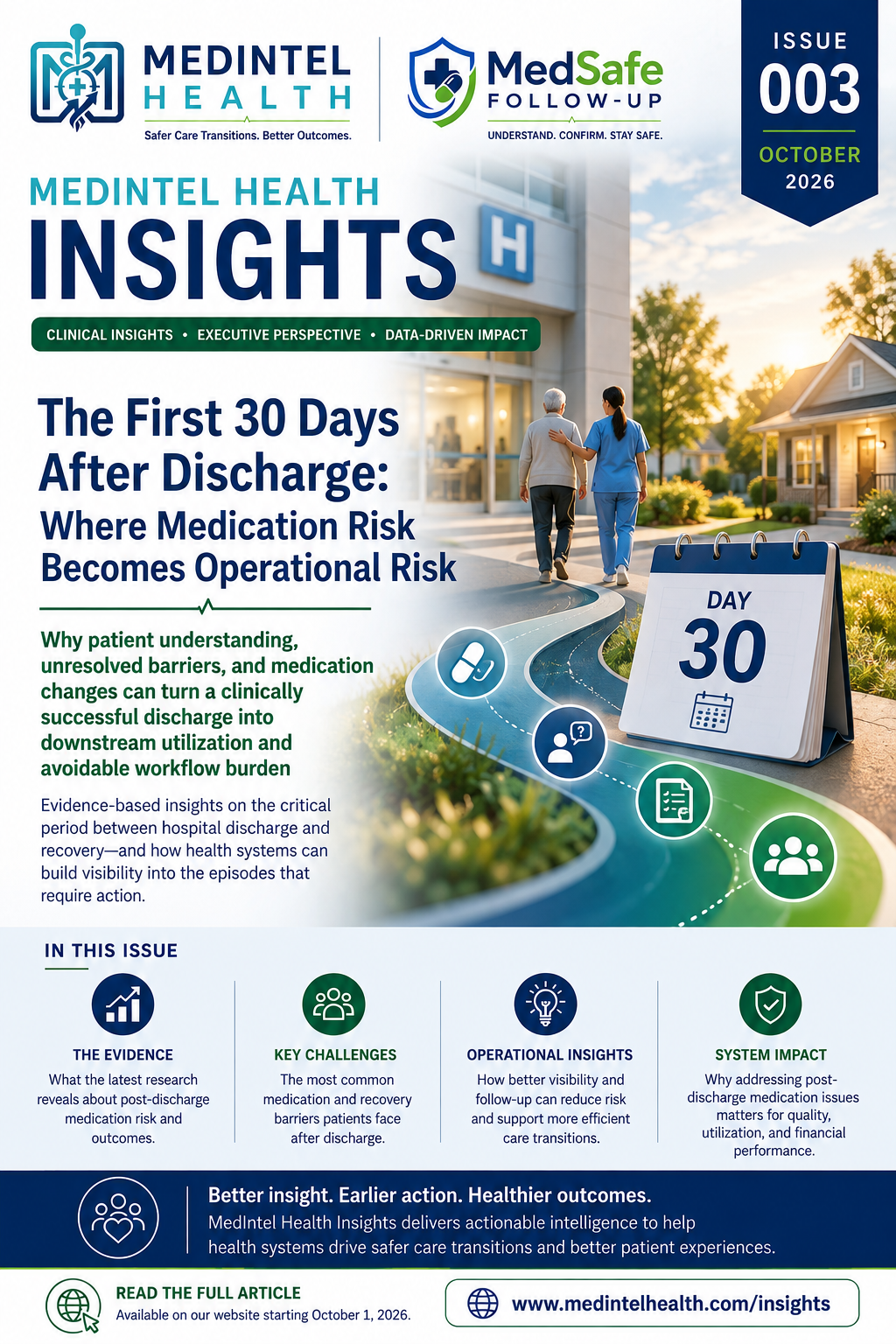
The First 30 Days After Discharge: Where Medication Risk Becomes Operational Risk
October 1, 2026 · 9 min readRead Article

MedIntel Health develops practical clinical technology that extends visibility beyond the discharge event. Our flagship platform, MedSafe Follow-Up, helps patients better understand and manage recovery while giving hospitals a structured view of medication and recovery needs that may require attention. Patient-reported signals can be prioritized, routed, resolved, and measured through a focused post-discharge workflow—without requiring a patient app or account or initial EHR integration.
Operating Principle
MedIntel technology is designed around a simple care-transition workflow.
Surface medication-understanding gaps and actionable recovery barriers after discharge.
Organize patient signals so care teams can focus on episodes requiring attention and direct the appropriate need to the appropriate resource.
Support structured follow-up and documentation using the hospital’s existing care team.
Turn patient signals, follow-up activity, barrier resolution, and outcomes into operational analytics and executive reporting.
Flagship Platform
MedSafe Follow-Up is a focused post-discharge visibility and workflow layer designed to complement existing hospital systems and care-team processes—not replace the EHR or care-management platform. It helps patients better understand and manage recovery while giving hospitals structured visibility into medication and recovery needs during the 30-day post-discharge period.
No patient app or account. No initial EHR integration required. The current pilot is designed to operate without PHI stored in MedSafe.
Patients can surface defined medication and recovery needs while the hospital receives structured information to help prioritize episodes requiring attention.
Evaluate patient understanding, barriers, follow-up activity, resolution, Day-30 outcomes, and program trends through operational analytics and executive reporting.
The initial hospital pilot allows an organization to evaluate the workflow and its own clinical, operational, and patient-support results before making a purchasing decision.
A concise overview of the patient experience, medication education, comprehension assessment, barrier identification, prioritized clinical follow-up, recovery-concern reporting, and quality-improvement workflow.
Approximately 3 minutes
MedSafe Follow-Up brings patient-reported signals, structured care-team workflow, and executive-level measurement into one post-discharge view — from visibility and prioritization through resolution and reporting.
Prioritized post-discharge episodes and follow-up activity in one operational view.
Leadership-ready reporting on program activity and measurable follow-up results.
Barriers, resolution, and Day-30 outcomes evaluated across the program.
Why It Matters
Medication changes, comprehension gaps, access problems, side effects, and other recovery barriers can emerge after a patient leaves the hospital. Earlier visibility can help identify needs that may otherwise remain unseen.
Potentially addressable post-discharge needs may contribute to emergency care, readmissions, clinical workload, quality-performance exposure, and financial burden. MedSafe Follow-Up is designed to help organizations surface defined needs earlier during the 30-day post-discharge period.
Structured patient signals can help care teams focus limited clinical resources on episodes where follow-up is most relevant rather than relying solely on universal manual outreach.
The financial relevance of the 30-day period is also reflected in the CMS Hospital Readmissions Reduction Program, under which eligible hospitals may receive a payment reduction ranging from 0% to 3% based on applicable readmission performance.
Review CMS Hospital Readmissions Reduction ProgramThis does not mean every readmission is preventable, or that MedSafe Follow-Up independently reduces readmissions or guarantees financial savings.
Platform Roadmap
MedIntel Health is developing additional clinical workflow frameworks around medication reconciliation, discharge understanding, and transitions between care settings.
Medication-reconciliation and transition documentation framework.
Structured teach-back and discharge-understanding framework.
Post-acute handoff and medication-change communication framework.
These frameworks are under active development and are not commercially available products.
Insights
Executive Insight
Issue 003
Care-Transition Brief
Brief 001
Leadership

Founder & Managing Director
Durade Zebari, PharmD, B.S. is Founder & Managing Director of MedIntel Health LLC and developer of MedSafe Follow-Up. Drawing on frontline hospital experience in medication safety, patient education, care transitions, and quality improvement—and with input from clinical and operational advisors—his work focuses on practical technology designed to improve post-discharge visibility and help healthcare organizations identify, prioritize, and address defined medication and recovery needs.
Collaboration
We welcome conversations with healthcare professionals, industry partners, advisors, and organizations interested in advancing practical care-transition technology.
Explore Partnership OpportunitiesMedIntel Health is preparing hospital pilot partnerships for organizations interested in evaluating a low-burden, measurable approach to post-discharge patient support, clinical visibility, structured follow-up, and organization-specific reporting.
Contact
For healthcare partnership, pilot, or product inquiries, contact MedIntel Health LLC.
Founder & Managing Director
dzebari@medintelhealth.comPartnerships
partnerships@medintelhealth.comGeneral Inquiries
info@medintelhealth.comProduct Operations
admin@medsafefollowup.com